WordPress vs Shopify vs Custom Website: Which Is Right for Your Business?
By UXplorers Team
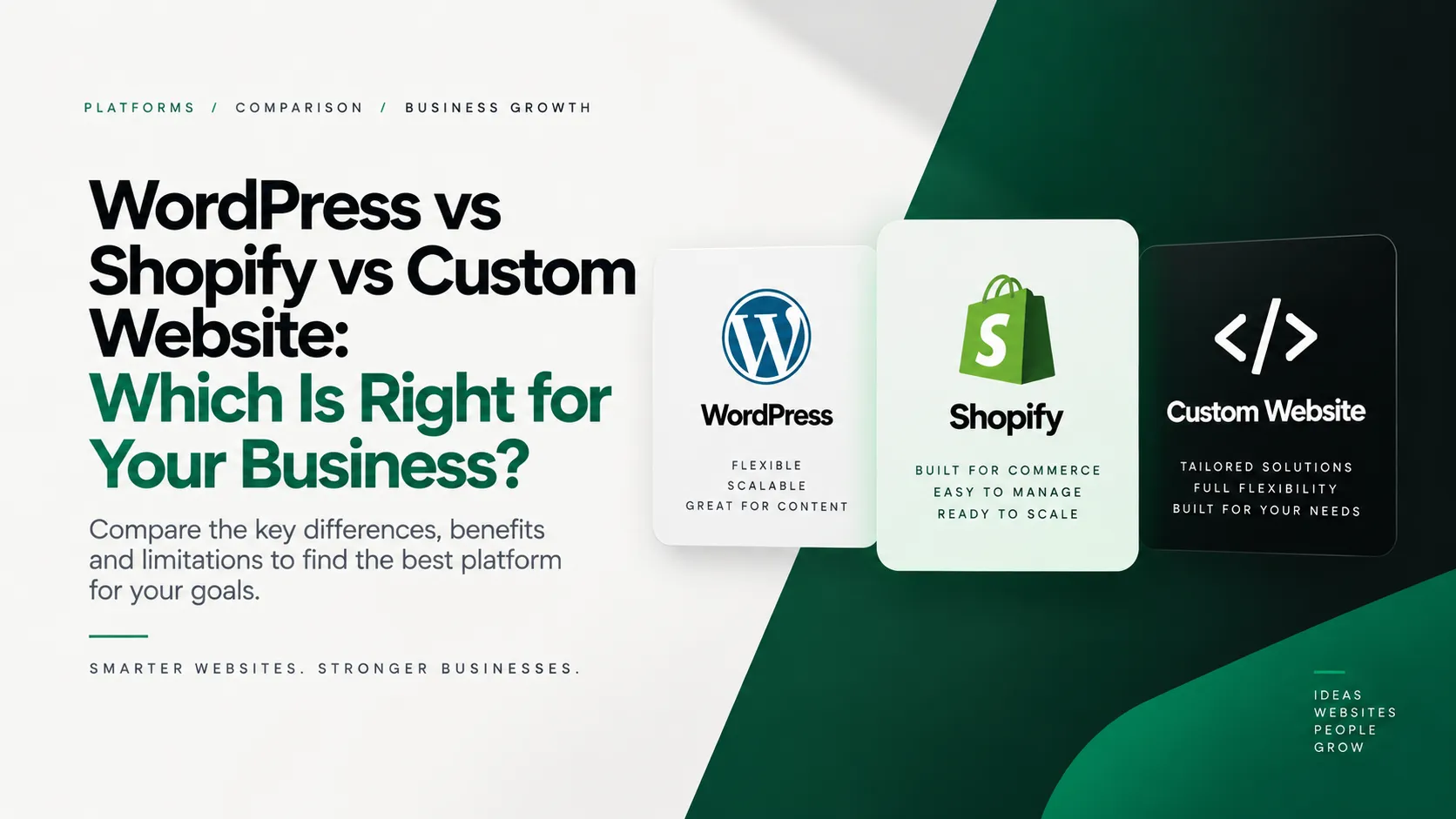
Choosing how your website should be built can quickly become confusing.
One person recommends WordPress. Someone else says Shopify. A developer tells you custom development is the better long-term solution.
The reality is simpler: there is no universally best platform.
The right choice depends on what your business sells, what your customers need to do, your budget, your internal team and how you expect the website to evolve.
Let's look at three common approaches.
What Is WordPress?
WordPress is a flexible content management system used for everything from small business websites to large content platforms.
One of its biggest advantages is flexibility. Businesses can manage pages and content while developers can extend the platform with custom functionality when required.
For service businesses, professional organisations and content-driven websites, WordPress can provide a strong balance between flexibility, control and cost.
- Service and professional businesses
- Corporate websites
- Content-rich websites
- Businesses requiring flexible page management
- Websites requiring bespoke designs without completely custom infrastructure
What Are the Disadvantages of WordPress?
WordPress requires proper maintenance.
Plugins, themes, security, backups and updates need to be managed responsibly. Poorly built WordPress websites can also become slow and difficult to maintain when unnecessary plugins and heavy page builders are used.
The platform itself isn't automatically fast or slow. Much depends on how the website is designed, developed, hosted and maintained.
What Is Shopify?
Shopify is built specifically around ecommerce.
Products, inventory, checkout, payments, discounts and order management are central to the platform rather than functionality that needs to be added afterwards.
That makes Shopify particularly attractive for businesses whose website exists primarily to sell products online.
- Ecommerce-first businesses
- Retail brands selling physical products
- Businesses wanting straightforward product management
- Companies that want established ecommerce infrastructure
- Growing online stores that need an extensive app ecosystem
What Are the Disadvantages of Shopify?
Shopify's biggest strength can also be a limitation.
Because you're operating within Shopify's ecosystem, certain highly specific functionality or experiences may require apps, workarounds or custom development.
Subscription costs and paid apps can also accumulate as the store becomes more sophisticated.
For most conventional ecommerce businesses this trade-off can be worthwhile, but it should still be considered before choosing the platform.
What Is a Custom Website?
Custom development means building the website or application specifically around your requirements rather than relying primarily on an existing CMS or ecommerce platform.
Modern technologies such as React and Next.js can be used to create highly tailored interfaces, platforms and web applications.
Custom development provides much greater freedom, but that freedom comes with increased development time, cost and technical responsibility.
- Web applications and digital platforms
- Businesses with unique workflows
- Complex third-party integrations
- Highly specialised functionality
- Products that need greater technical flexibility
- Businesses whose website is part of their core technology
WordPress vs Shopify vs Custom Development
If you're building a conventional business website, WordPress will often provide the flexibility you need without the cost of developing an entire platform from scratch.
If your primary goal is selling products online, Shopify can remove a significant amount of ecommerce complexity.
If your requirements involve unique functionality, workflows or a digital product that doesn't comfortably fit either platform, custom development becomes much more compelling.
The decision should follow the requirements, not the other way around.
Don't Choose Technology Before Understanding the User
A common mistake is deciding on the platform before understanding what the website actually needs to accomplish.
Businesses sometimes start conversations with "We need a WordPress website" or "We want Shopify" when the more useful starting point is understanding the customer journey.
Who will use the website?
What are they trying to accomplish?
What information do they need?
What could prevent them from converting?
What does your team need to manage internally?
Once those questions are answered, choosing the technology becomes much easier.
Think About Where Your Business Is Going
Your current requirements matter, but so do your future ones.
A small ecommerce business may only need fifty products today but could eventually sell internationally, integrate with fulfilment systems or operate multiple storefronts.
A service company might eventually require customer accounts, booking systems or integrations with internal software.
You don't need to build every future feature immediately. You should, however, avoid making today's decision in complete isolation from tomorrow's plans.
So Which One Should You Choose?
- Choose WordPress when you need a flexible, professionally managed business or content website.
- Choose Shopify when ecommerce is the core purpose of your website and you want mature commerce infrastructure.
- Choose custom development when your requirements are sufficiently unique that existing platforms would create more limitations than benefits.
The Best Platform Is the One That Fits the Business
There isn't a trophy for choosing the most sophisticated technology.
A £50,000 custom application is a poor investment if a well-built WordPress website could solve the same problem. Equally, forcing complex business requirements into a collection of plugins simply to avoid custom development can create problems later.
At UXplorers, we work across WordPress, Shopify and custom web development. That allows us to recommend technology based on the project rather than forcing every client into the same solution.
We start with your business, your users and your objectives. Then we determine the most appropriate way to build it.
If you're planning a website and aren't sure which direction to take, speak with UXplorers and we'll help you understand the options.